Potential-Induced Degradation (PID) is one of the most serious reliability challenges for modern photovoltaic modules. In high-efficiency TOPCon modules, the risk is even greater because the glass–cell interface becomes especially vulnerable. Here, the electrical and chemical behavior of the encapsulant is critical: if moisture or ions are allowed to move, localized leakage paths can form and quickly degrade performance. For this reason, the encapsulant should not be seen as simple packaging, but as a key functional layer that maintains insulation resistance, suppresses ion migration, and protects long-term module stability.
To check PID resistance, modules are exposed to a system voltage of up to1500 V at 85 °C and 85 % relative humidity for durations from 96 to 192 hours, depending on the protocol. After the duration is passed under the testing conditions, power performance is measured to quantify PID-related degradation. In practical terms, a module is generally considered PID-resistant if the power loss remains below 5 % after testing.
Acid-Free (Low Acid) Formulation for TOPCon Stability
TOPCon solar cells achieve their high efficiency thanks to an ultra-thin tunnel oxide and doped polysilicon layers. These layers are powerful—but also delicate. They are particularly vulnerable to sodium-ion migration caused by moisture ingress.
Over years of field operation, conventional formulations release acetic acid from vinyl acetate content in EVA. This acidic byproduct gradually lowers surface resistivity and accelerates unwanted electrochemical reactions at the cell interface. In practice, it creates the perfect conditions for leakage currents and ionic movement which trigger PID.
Acid-free (low acid) encapsulants address the problem at its source. By maintaining chemical neutrality during lamination and throughout long-term operation, they prevent acid-driven ion mobility from developing in the first place.
Dr. Hans Werner Chemikalien’s acid-free (low acid) EVA and EPE solutions are designed with this exact challenge. Even after prolonged exposure to harsh conditions such as 85 °C and 85 % relative humidity, modules can maintain electrical stability and demonstrate PID power loss below 3 % in demanding tests like PID192h—providing stronger reliability margin for modern TOPCon modules.
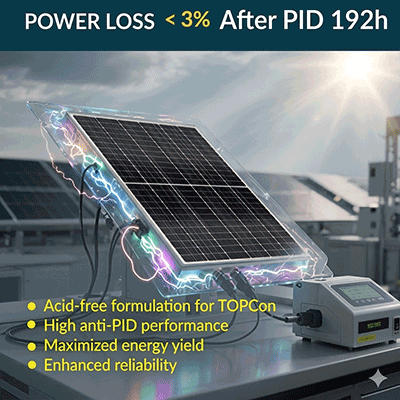
High Anti-PID Performance Controlled by Material Level
Effective PID suppression starts with the right material design. High volume resistivity limits unwanted charge movement, while a uniform crosslinked structure forms a dense, stable network that blocks ion migration. Low moisture absorption further reduces electrochemical activity at the glass–cell interface, helping the module maintain strong insulation even under high temperature and humidity.
Long-term PID resistance also requires electrically stable additives that remain inert under continuous voltage, heat, and moisture. This stability is confirmed through tests such as gel content uniformity, resistivity retention, dielectric strength, and extended damp-heat exposure. Through performance controlled at the material design level, acid-free (low acid) encapsulants preserve insulation integrity by combatting PID-related power losses.
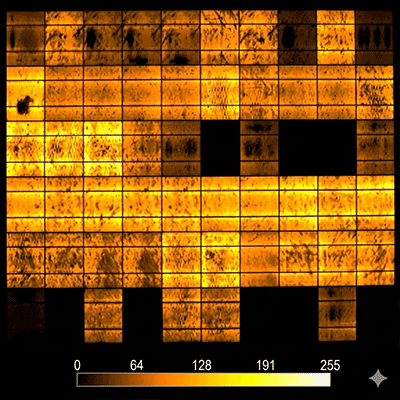 Sample EL Image: Significant Power Losses due PID Effect (Regular Encapsulants)
Maximized Energy Yield Across the Module Warranty Lifetime
PID has a direct and measurable impact on module performance. In large PV arrays, even relatively small PID-related losses at the module level can accumulate across many strings, leading to a noticeable drop in overall performance and preventing the system from achieving its maximized energy yield. This makes effective PID resistance especially critical during the early years of operation, when electrical stress and degradation risk are highest.
Acid-free encapsulants help reduce this risk by maintaining high insulation and stopping unwanted charge build-up at sensitive cell interfaces in TOPCon modules. When PID losses remain tightly controlled, even under accelerated stress tests, modules perform closer to design targets—supporting predictable operation and maximized energy yield throughout the service life.
Enhanced Reliability
PID resistance is closely linked to long-term module reliability, and the use of acid-free encapsulants plays a critical role in achieving this stability. By eliminating acid generation during lamination and aging, acid-free formulations help preserve high insulation resistance, protect sensitive metallization and passivation layers, and reduce the risk of corrosion at the cell interfaces. This chemical neutrality supports durable glass–polymer adhesion and strengthens the module’s resistance to moisture ingress, slowing the formation of humidity-driven conductive pathways that can compromise electrical performance over time. Consistent PID resistance demonstrated in accelerated stress tests supports qualification for extended durability programs and standard requirements as well as manufacturer specifications.
Conclusion
As TOPCon solar cell technology continues to set the benchmark for high-efficiency solar modules, the choice of encapsulant type becomes increasingly critical to long-term reliability. The right material selection can significantly reduce PID risk and protect module performance over time. Acid-free chemistry, high volume resistivity and low moisture absorption all work together to suppress PID at its root causes.
Acid-free EVA and EPE solar encapsulants from Dr. Hans Werner Chemikalien, with PID power loss consistently maintained below 3% under accelerated stress conditions, provide a dependable material solution for utility-scale, and long-warranty TOPCon applications.